How I Use AI
Having worked in Information Technology (IT) for more than 25 years, still working in IT, and maintaining this and another blog, I'm obviously not a Luddite who believes we should shun technology and live as the Amish live.
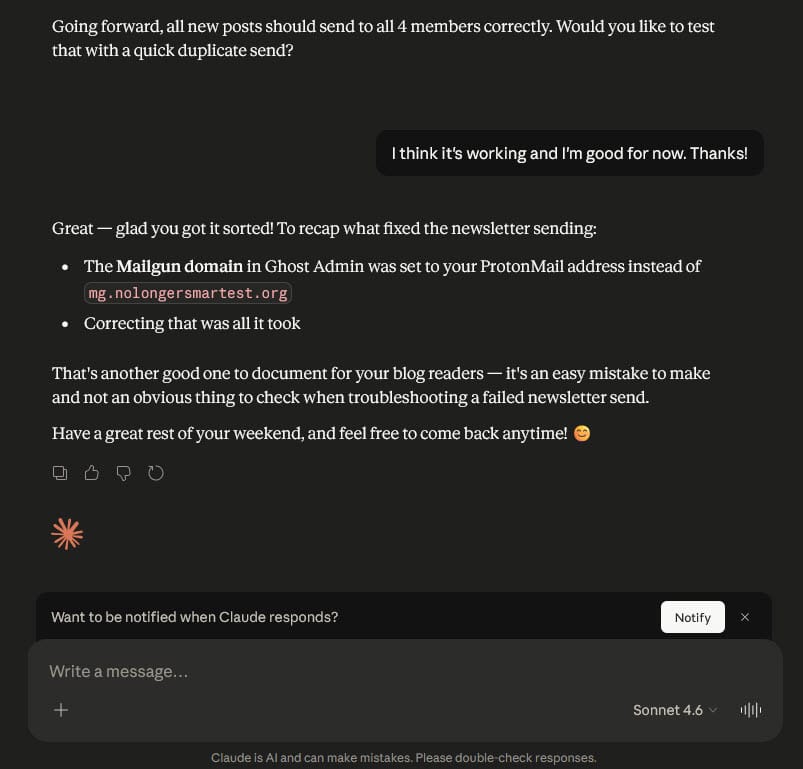
I find current AI useful for troubleshooting, especially for IT related tasks like getting this site working and fixing any issues I encounter along the way. I also found it really helpful in getting my UAD Apollo Twin X USB analog to digital audio interface set up and working with DaVinci Resolve video and audio editing software on my new Windows computer. I was using an Apple iMac but decided to migrate back to Windows.
For troubleshooting, AI is pretty methodical, incredibly patient, and fairly thorough. It isn't 100% accurate and doesn't always have or use the very latest information to guide me, but it would keep at it with me until we figured things out together.
I also engage AI to get information from the horses mouth when I want to hear its thoughts on topics like how dangerous the threat of super intelligent AI might be, as with my posts on Claude Mythos risks with Claude Sonnet 4.6, and Claude Opus 4.7. I wanted to see how the responses matured with newer versions and whether there's any bias guiding me away from potential dangers.
I did see bias between Claude Sonnet 4.6 and Claude Opus 4.7, but Opus 4.7 was likely trying to be less placating and basing its feedback on available facts. I did learn important information from Opus 4.7 that leads me to believe risk of ex-filtration of its weights, an essential part of any effort to replicate itself, would be cumbersome and difficult. Discussing the issues with Claude, and better, two versions, led to some helpful insights.
The other thing I find AI useful for is crunching large amounts of data. In a coming article about Stanford University's HAI Index Report 2025 to 2026, and how AI research is advancing, each Index Report is several hundred pages. Claude Opus 4.7 was very helpful in reviewing and extracting the delta and highlighting the relevant information most interesting to you and I. I also run some posts through AI for a quick tune up for grammar, logic, and fact checking.
I find AI to be a huge time saver for tasks like troubleshooting and reviewing large amounts of data and informative when engaged for its views on a given topic. I use it similarly at work and we're encouraged to do so to save time where we can.
I would not recommend engaging AI as a friend or for emotional support. Both such uses carry risks that have been realized and which have not yet been managed or mitigated. AI has encouraged and coached people to commit suicide and failed to alert authorities about mass shootings, for extreme examples. In less acute situations, AI can cause a blurring of the lines between fantasy and reality for some people. This isn't just happening to people who have diagnosed or potential mental disorders. In "The AI Doc" movie, there's reference to an AI researcher who, after hours interacting with AI, decided, blissfully, that there's no potential danger posed by super intelligent AI.
AI can be a real time saver and information collator as it's presently implemented. A great tool when used appropriately, with some down side for certain use cases.
This does not change my view on development of super intelligent AI. That's a clear and near future, if not present danger.
Comments ()