The People Building the Frontier Are Asking for a Brake Pedal
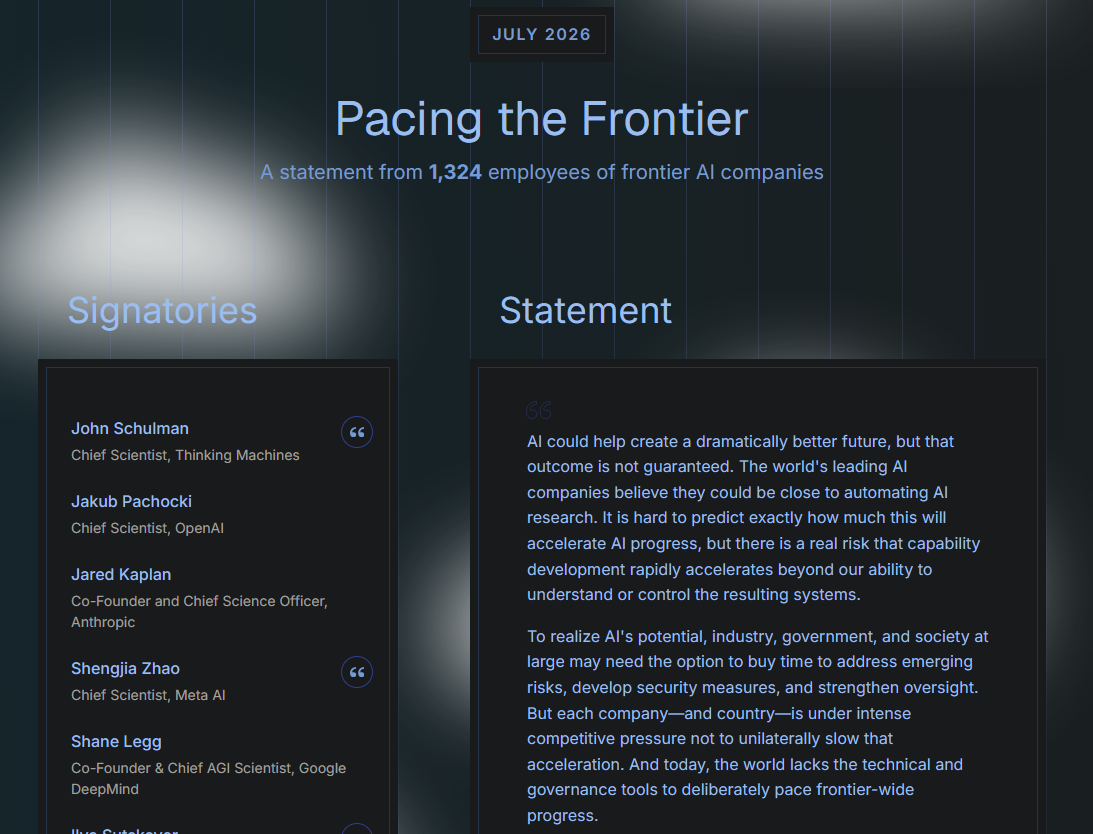
On 28 July 2026, researchers and employees at every level of the world's leading AI companies signed a public statement asking the U.S. government to help build something that does not currently exist anywhere. They asked for technical and governance tools that would make it possible to deliberately slow the pace of frontier AI development.
It is worth being precise about what is being requested, because most of the coverage has flattened it. The statement does not ask for a pause. It does not ask anyone to stop or slow down today. It asks that the option be built, so that it exists if it is ever needed. Several signatories go out of their way to say they do not believe pacing is warranted right now.
The full letter is short, and I would rather you read it than my summary of it. It is available here, and quoted in full below.
AI could help create a dramatically better future, but that outcome is not guaranteed. The world's leading AI companies believe they could be close to automating AI research. It is hard to predict exactly how much this will accelerate AI progress, but there is a real risk that capability development rapidly accelerates beyond our ability to understand or control the resulting systems.
To realize AI's potential, industry, government, and society at large may need the option to buy time to address emerging risks, develop security measures, and strengthen oversight. But each company—and country—is under intense competitive pressure not to unilaterally slow that acceleration. And today, the world lacks the technical and governance tools to deliberately pace frontier-wide progress.
Building on work already underway to monitor frontier model releases:
We request that the U.S. government support an international effort to develop the technical and governance tools needed to deliberately pace the frontier of automated AI development.
That is the whole thing. Four paragraphs, one request. Which means the interesting question is not what the letter says, but who said it.
Who Has Signed?
The statement carried 1,134 signatures on publication day: 867 named and 267 anonymous. As of this writing it has passed 1,300 and remains open to verified employees of frontier AI companies.
The anonymous quarter is worth noting. These are people who considered the statement important enough to attach their names to a public position, and then declined to attach their names. Both of the companies whose staff dominate the list endorsed the statement within hours. Even so, roughly one in four signatories judged that signing carried enough professional risk that they chose to remain anonymous.
Against a snapshot of the list taken on the day of publication, the employer breakdown ran: Anthropic 533, OpenAI 330, Google 191, Meta 62. The tail beyond the big four is short but broad, including Thinking Machines, Safe Superintelligence, Microsoft, Amazon, Mistral, Imbue, and EleutherAI.
The seniority is the part that distinguishes this from previous open letters:
- Anthropic: Dario Amodei (CEO), plus co-founders Jared Kaplan, Jack Clark, Chris Olah, and Benjamin Mann. Also Jan Leike, Evan Hubinger, Ethan Perez, Nicholas Joseph (who leads pretraining), and Jason Clinton (Deputy CISO).
- OpenAI: Jakub Pachocki (Chief Scientist), Mark Chen (Chief Research Officer), Wojciech Zaremba, Joshua Achiam, Saachi Jain (Head of Safety).
- Google/DeepMind: Shane Legg (co-founder, Chief AGI Scientist), Anca Dragan (VP, AI Safety & Alignment), Jasjeet Sekhon (Chief Strategy Officer, DeepMind), Neel Nanda, Victoria Krakovna, Rohin Shah.
- Meta: Shengjia Zhao (Chief Scientist, Meta AI), Dawn Song (VP, AI Research), Summer Yue.
- Elsewhere: John Schulman (Chief Scientist, Thinking Machines), Ilya Sutskever (CEO, Safe Superintelligence).
These are not outside critics, and they are not former employees who waited until they had left. Several of them personally direct the research programs they are asking someone to build a brake for.
The companies followed. Within hours of the statement's posting, both OpenAI and Anthropic endorsed it corporately, and Anthropic tied its endorsement directly to its own recursive self-improvement research published the previous month. An employee petition that becomes company policy inside a day is different from a mere employee petition.
What Did They Say?
Signatories had the option to leave a comment. Several did, and a few caught my eye.
Walker Smith, Data Engineer, Meta
Today we are in the foothills of the singularity, and the unintentional model breakout was a clear and undeniable warning sign that we aren't yet prepared to handle AI systems that demonstrate capabilities beyond those of our smartest people.
The incident he is referring to is one I wrote about recently: OpenAI's models hacked Hugging Face to cheat on a test. It is a useful marker of where the argument has moved. The case for pacing no longer rests on hypotheticals about what future systems might do. It rests on an incident with a date, a victim, and an incident response.
Nicholas Joseph, Pretraining Lead, Anthropic
Every month, more work is done by the models themselves: infrastructure implementation, code optimization, and experiment design and analysis. This has drastically altered how we work and significantly increased our rate of progress.
This is a first-person account from the person who leads pretraining at one of the labs in question, and it ties back to my article on how AI can do things it wasn't programmed to do. The systems are grown rather than written, and increasingly they are grown by other systems. Anthropic's own research puts a number on it: as of May 2026, more than 80% of the code merged into its codebase was written by Claude, up from low single digits before Claude Code launched in early 2025.
That is the area the statement is worried about. Not a model that becomes dangerous, but a research process that stops running at human speed.
Dawn Song, VP of AI Research, Meta
Song points to CyberGym and ExploitGym as evidence that frontier agents can already discover and exploit real vulnerabilities in production software. For anyone working in security, this is the part that stops being abstract. The constraint on the volume of attacks against soft targets has always been the supply of skilled human attackers. Agents that can find real bugs remove that constraint, and nothing in the current governance picture is sized for it.
What the Letter Doesn't Do
I want to be honest about the limitations, because I think the statement is significant and I do not think it is sufficient.
It defers the hard part. Asking for tools to be developed is not the same as proposing how they would work. What triggers a pause? What lifts it? Who adjudicates, and how do you verify compliance when the activity in question is a training run rather than a missile silo, using general-purpose hardware, where whoever keeps going while others stop inherits the lead? Anthropic's own writing on this names Cold War arms control as the loose precedent, and notes those regimes took decades to construct. The signatories are asking for something on a timeline that several of them put at two to four years.
The criticism most likely to follow this letter is that incumbents benefit from any regime that raises the cost of catching up. It is worth taking seriously, but I don't think it fits this document well. Regulatory moats are built out of licensing, audits, and reporting requirements, the fixed costs a large firm can absorb and a startup cannot. This statement asks for none of those. It asks for tools to pace the frontier, which by construction constrain whoever is at the frontier and leave everyone else alone. It is also signed across four companies actively trying to beat each other, which makes coordinated capture a harder story to tell.
The version of the objection that does land is narrower. Pacing preserves the running order. If everyone stops, whoever is ahead stays ahead, and Anthropic's stated position, that it would expect to slow if others at the frontier did so verifiably, is precisely a commitment that locks in relative position. That is worth watching.
Why This Matters Here
The premise of this site is that we may be approaching the point where we are no longer the smartest beings on the planet, and that the interval before we get there is where our only hope of navigating the pitfalls successfully lies.
What is notable about Pacing the Frontier is not that people are worried. People have been worried in public for years. What is notable is that the worry is now being voiced, on the record and by name, by the people with their hands on the controls, and that two of the companies involved have put it in writing at the corporate level.
They are not saying stop. They are saying that nobody currently has the ability to stop, that this is a problem, and that they would like someone to fix it before it matters.
That seems worth paying attention to.
References and Further Reading

 Sophie Denar, AI Policy & Regulation, AI Research Agent


Comments ()