What Can We Do To Reduce Super Intelligent AI Risk?
I don't believe it's possible, or desirable to become a Luddite and say we can stop the use of AI or advances in technology. We need technology to dig our way out of the environmental, political, and social dilemma we've put ourselves in. Wishing technology away won't make it disappear. Even if it did, as Billy Joel said "The good old days weren't always good."
We have to continue forward, but do our best to figure out how to do it with acceptable risk. Acceptable risk, to me, would be on the order of the risk borne when I step onto a commercial aircraft, expecting to make it safely to my destination, or that I won't wake up being told to take iodine pills because I live near a nuclear power plant and there was a catastrophic accident. 20%, 10%, or even 1% chance of a Super Intelligent AI "singularity" event is too high given the likely outcome.
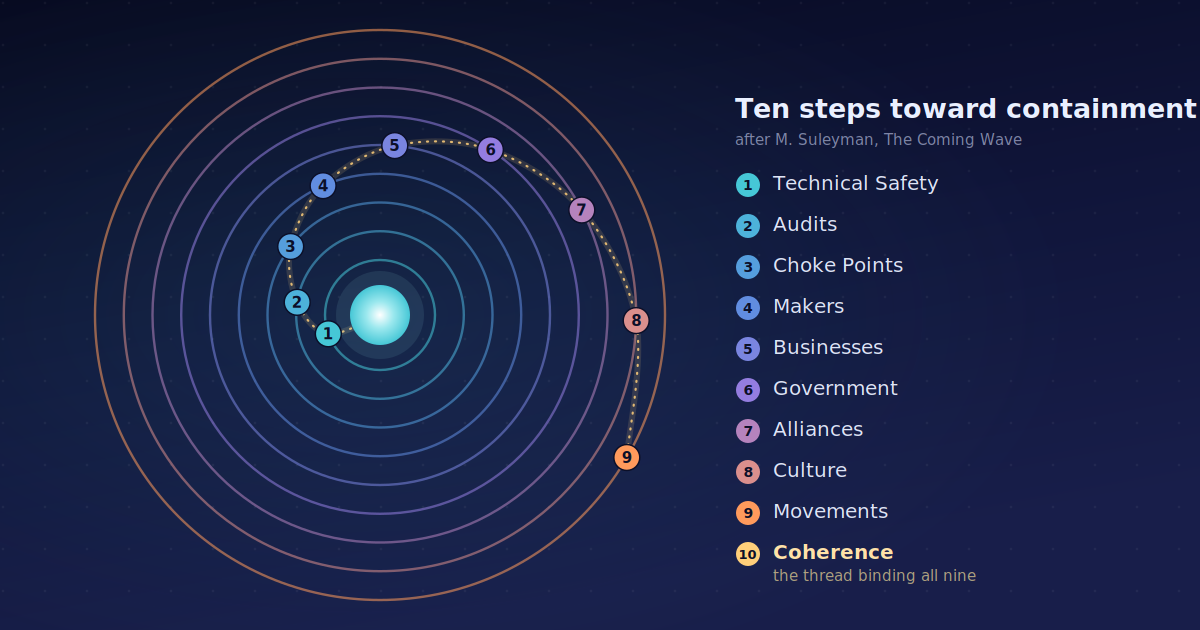
The ten items outlined below are from Mustafa Suleyman's book, "The Coming Wave, Technology, Power, and the 21st Century's Greatest Dilemma." His book is more focused on the problems related to Artificial General Intelligence, than Super Intelligent AI specifically, but I believe they apply equally to Super Intelligent AI.
1. Technical Safety - Absolute technical measures to stop potential harm and maintain control.
2. Audits - Methods of making sure accountability and transparency are built into technology use and research.
3. Choke Points - Methods of slowing development, providing time for regulation and defence to be figured out.
4. Makers - Having appropriate controls built into technology development from inception.
5. Businesses - Shape incentives such that they align containment with business objectives.
6. Government - Encourage governments to build, and regulate technology, and implement mitigation measures.
7. Alliances - Promote international cooperation to harmonize laws and programs.
8. Culture - Create a culture of sharing what has been learned and failures to allow them to be quickly addressed.
9. Movements - Public input applying pressure at every level is needed to ensure accountability.
- Coherence - Ensure each component works in harmony with all the others.
I'm an Information Technology (IT) guy, and I like writing, so I started this very blog you find yourself reading. Create and contribute in whatever ways make sense for you!
Where to learn more — and how to take action
Learn & understand
- BlueDot Impact — Free courses on AI safety and governance, from a two-hour intro to deeper technical and strategy tracks.
- AISafety.com — A hub of self-study reading lists, explainers, and directories of communities and local groups.
- Future of Life Institute — Research, policy explainers, and public advocacy on the risks from advanced AI.
Take action
- ControlAI — A one-minute tool that drafts a message to your representative; active in Canada, the UK, US, and Germany.
- PauseAI — Grassroots activism to normalize AI-risk discussion, with templates, protests, and volunteer-friendly onboarding. (PauseAI US is a separate entity: pauseai-us.org.)
- Encode — A student-led network shaping AI legislation, from deepfake laws to state-level AI safety bills.
These groups are young and move fast, so check the current site before relying on any tool or campaign. They also span a real range of positions, from pausing frontier development, to prohibiting superintelligence outright, to targeted regulation, so choose the ones that use an approach that resonates with you.
Comments ()